Mermaid swimlanes
Use native Mermaid 12.2.0 swimlane-beta input. Top-level subgraphs are ordered
responsibility lanes; nested subgraphs remain groups. Nodes outside every lane
stay unowned. This format describes steps and interactions without BPMN execution
semantics. Ordinary flowchart and graph headers remain unsupported inputs.
TB is the default direction. TD aliases TB; BT, LR and RL reverse
or rotate the flow axis. Lane order stays left-to-right for vertical flow and
top-to-bottom for horizontal flow, including reverse directions. Local directions
belong to their lane or group. They never change a connection's logical endpoints.
Read, print and render
The Mermaid module guide contains
compiled examples of read_diagram, print_diagram and to_swimlane. The new
parsed-diagram union dispatches sequence and swimlane source. Existing read,
print, ReadResult, sequence AST/CST types and to_sequence retain their
sequence-only contracts. render_svg(source) dispatches both supported kinds
and returns diagnostics with absent output on failure.
Source reproduction keeps all original text, including malformed regions, comments, CRLF, front matter and quote spelling. Canonical printing writes one statement per line with two-space group indentation and preserves statement order. Diagnostic spans use half-open UTF-16 offsets and one-based line/column positions.
The model keeps distinct parallel connections, endpoint markers, line style, minimum-length hints, shape identities and decoded labels. Generated identities are deterministic. Repeated lane declarations merge membership while retaining the first completed database registration's title, direction and position. A nested repeat can complete before its outer declaration.
Static views
Compare the review example in dark and light, or read the native source. The gallery also contains all four effective directions and empty, unowned, nested and collapsed scopes.
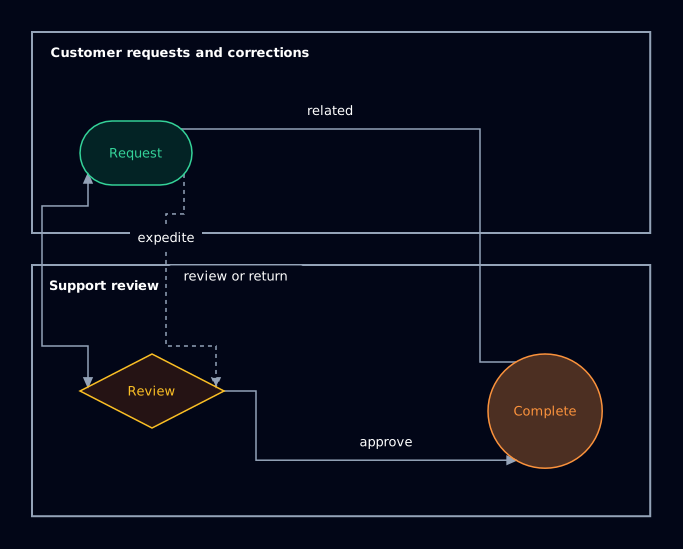
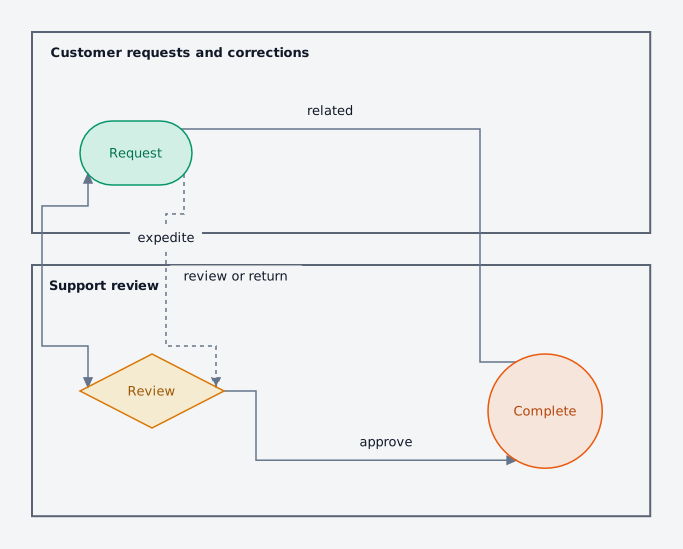
The SVG module guide describes geometry, themes, limits and the public legibility checker. Static output is standalone, script-free SVG. Explicit ID prefixes isolate inline copies. Shared connector updates deliberately change affected sequence, BPMN and swimlane SVG bytes for default bridge hops and longer marked approaches. Explicit styles also change display geometry. Source identities, semantic endpoints and query results stay stable; portable snapshots and browser checks qualify the visual updates.
Built-in vector shapes and their aliases use the shared diagram palettes. Image/icon assets and unknown shapes return explicit errors without output or resource fetches. Markdown and HTML labels use safe text projection, with diagnostics for unsupported formatting. Author CSS, callbacks and Mermaid renderer configuration remain source metadata; they do not execute or override explicit library renderer options.
Follow interactions
Open the review player in dark or light, or inspect an explicit reverse traversal or a finite concurrent scenario. Play, pause, seek, speed, keyboard controls, reduced motion and hidden-page suspension use the same offline player as sequence and BPMN. Download SVG returns the canonical static bytes without overlays and preserves viewer state.
Choose a specific Connection and Show connection to inspect a parallel handoff by its own ID; Play then follows only that connection. Structural routes follow endpoint markers. A marker on one end points toward that end; markers at both ends permit either traversal. Headless connections are available only with the explicit unheaded-connection option. Invisible connections constrain layout but create no playback occurrence or route. Lane membership and visual proximity never add a path.
Catalog::swimlane retains typed source connections. Route.reversed records
the orientation of every route edge. Motion::OrientedStep samples a path in that
orientation without changing its endpoint markers. Motion::Step keeps its
existing forward-path behavior. Finite scenarios can repeat an occurrence or use
concurrent branches. Neither routes nor scenarios evaluate conditions, execute
callbacks, simulate tokens or assert a feasible business process.
Collapsed groups show their label and boundary. Cross-boundary handoffs attach visually to the nearest visible ancestor while retaining their logical endpoints. Hidden descendants remain outside route-query scope. An explicitly declared group endpoint is distinct from an anchor used only for display.
Compatibility and qualification
Callers with exhaustive matches must handle Diagram::Swimlane, the new animation
occurrence/endpoint/edge kinds, Motion::OrientedStep and the SVG binding variant.
The shared browser runtime can change old animated HTML bytes; old sequence/BPMN
playback contracts and static SVG bytes remain covered by qualification.
The native beta grammar and test oracle are pinned to Mermaid 12.2.0. Production
code does not invoke Mermaid or JavaScript. Library tests cover wasm, wasm-gc,
js and native. Run mise run gallery to generate review artifacts, mise run test:svg for static browser checks and mise run test:animation for offline
motion and canonical export. Limits reject excessive source, nesting, expanded
edges, work and output rather than presenting partial output as complete.